
Bing Ads: The Complete Guide (Microsoft Advertising)



Already running Google? You're leaving Bing on the table.
33–40% lower CPCs, a fraction of the competition. We run it at scale, not as an afterthought.
Talk to our Bing Ads team
Bing Ads, now officially called Microsoft Advertising, is the second-largest paid search platform in the world. Most advertisers ignore it. That’s the opportunity.
This guide covers what the platform is, how it differs from Google, which verticals over-perform, how to set up an account, what it costs, and when it makes sense to bring in a specialist. Written from the perspective of a team running $150M+ in paid search spend across channels, including Bing at scale.
If you’re already running Google Ads and looking for a second channel with lower CPCs and less competition, Bing is the most underpriced option in paid search right now.
What Are Bing Ads? (Microsoft Advertising Explained)
Bing Ads is the former name of Microsoft’s paid advertising platform, rebranded as Microsoft Advertising in 2019. The rebrand reflects how far the platform has expanded beyond Bing itself.
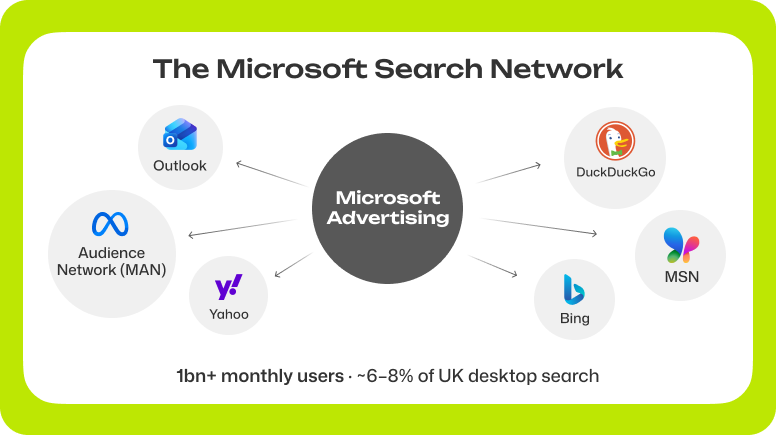
When you run a campaign on Microsoft Advertising, your ads appear on:
- Bing — Microsoft’s search engine, the default on Windows and Microsoft Edge
- Yahoo and AOL — still part of the Microsoft Search Network
- DuckDuckGo — which syndicates search ads from Microsoft’s network
- MSN and Outlook — high-traffic Microsoft-owned properties
- Microsoft Audience Network (MAN) — native display placements across MSN, Outlook, Microsoft Edge, and partner sites
That last one matters more than most advertisers might realise. The Microsoft Audience Network puts your ads in front of users who are browsing content. CPMs are significantly lower than Google Display, and audience quality is stronger because Microsoft uses its own first-party data rather than third-party signals.
The platform has a reach of over 1 billion unique monthly users globally. In the UK, Bing accounts for roughly 6–8% of desktop search volume. This is a meaningful slice of intent-driven traffic that advertisers might leave untouched.
Want a specialist to run this for you? See our Bing Ads Agency page.
Bing Ads vs Google Ads: What’s Actually Different
The two platforms share the same basic auction mechanics. You bid on keywords, ads appear in search results, and you pay per click. Everything else is different.
CPC Gap
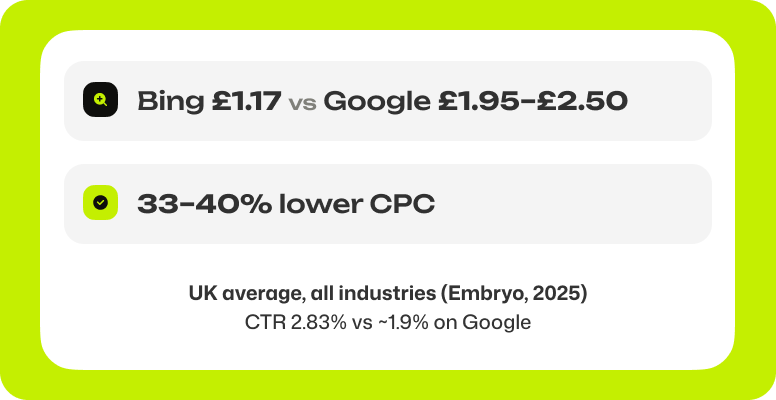
The average CPC on Bing across all UK industries is around £1.17, compared to £1.95–£2.50 on Google Search (Embryo, 2025). That’s a 33–40% cost advantage on a per-click basis. In competitive verticals like legal and finance, the difference widens further. For a full breakdown of Google’s cost structure, see our Google Ads cost guide.
Audience Differences
Bing’s user base leans more toward older and higher-income audiences. Around 40% of Bing users have a household income above $100,000 (Microsoft Advertising Insights, 2026). The demographic mix heavily favours B2B buyers and professionals in regulated industries with higher purchase intent and less price sensitivity.
This changes what works creatively and commercially. Offers that resonate with a 50-year-old finance professional will outperform generic DTC-style creatives. CPL expectations should reflect the higher average order value and conversion quality of this audience.
Competition Levels
Only 36% of US advertisers actively use Microsoft Ads, compared to 80% who use Google (SearchLab, 2026). UK figures follow a similar pattern. Less competition means lower auction floors across almost every keyword, which is why advertisers who run Bing well typically see stronger ROAS than on Google for the same keyword set, even accounting for the smaller volume.
The Microsoft Audience Network
This is the real differentiator. MAN gives you native display placements across Microsoft’s owned properties and partner network, with better audience quality than most programmatic alternatives. Microsoft uses its own first-party data, including LinkedIn profile data and Bing search history, to target these placements. Advertisers running Bing usually ignore MAN entirely. That’s a significant missed opportunity.
LinkedIn Profile Targeting
Microsoft’s acquisition of LinkedIn means you can target Bing Ads by job title, company, industry, and seniority level, directly inside search results. No other search platform offers this capability. For B2B campaigns targeting decision-makers, it changes what’s possible on paid search.
Who Should Advertise on Bing? (Verticals Where Bing Over-Performs)
Bing overperforms for any vertical where the ideal buyer is older, higher-income, or professionally oriented. That covers much more ground.
B2B and SaaS
The combination of LinkedIn targeting, a business-professional audience, and lower CPCs makes Bing the strongest secondary channel for B2B. Average ROAS in B2B on Microsoft Ads is 3.4:1 (Microsoft Advertising B2B Vertical Report, 2026). For SaaS companies running Google Ads at £3–£6 CPC on competitive keywords, Bing typically delivers the same intent at 40% lower cost per click.
Finance and Insurance
High-LTV conversions justify the higher absolute CPCs in these verticals. Bing’s audience skew means you’re reaching people with actual financial assets and purchase authority. CPCs in finance on Bing run £2–£4, compared to £4–£8 on Google for the same keywords.
Healthcare and Professional Services
Healthcare is the fastest-growing vertical on Microsoft Ads, with 42% more advertisers and 38% more spend year-over-year (Microsoft Advertising Healthcare Vertical Insights, 2026). The older Bing audience aligns directly with healthcare search patterns. GPs, specialists, private dental, and elective procedures all over-index on this demographic.
Legal
Legal CPCs on Bing typically run £5.70–£7.00 vs £8.58 on Google for comparable keywords (SearchLab, 2026). At those volumes, the cost difference compounds quickly.
eCommerce (Older-Skewing Products)
Standard DTC eCommerce may see lower volume on Bing, but categories like home furnishings, garden, financial products, and premium fashion perform well given the audience profile. Average ROAS on Microsoft Shopping campaigns in eCommerce sits at 4.6:1 (SearchLab, 2026).
How to Set Up a Bing Ads Account (Step by Step)
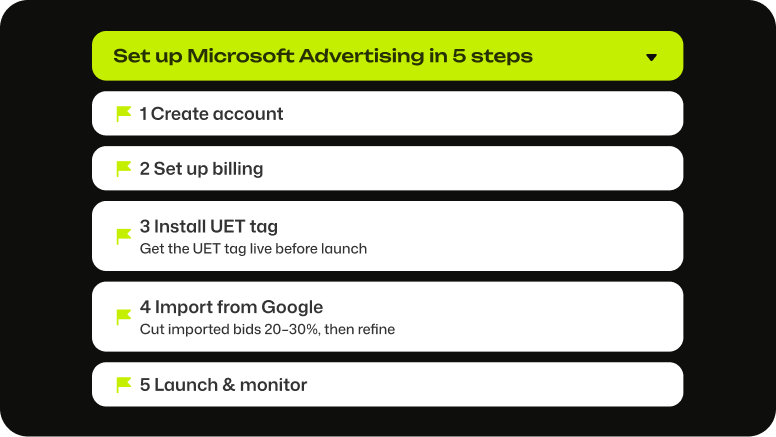
1. Create Your Microsoft Advertising Account
Go to ads.microsoft.com and sign in with a Microsoft account. If you have an existing Google Ads account, you can link it during setup to use the import tool later.
2. Set up Billing
Add a payment method under Billing & Payments. Microsoft Advertising supports credit/debit cards and monthly invoicing for qualifying accounts. UK accounts are billed in GBP.
3. Set up Conversion Tracking
Install the Microsoft Advertising Universal Event Tag (UET tag) on your website. This is equivalent to Google’s global site tag. It tracks conversions, enables remarketing, and feeds the Smart Bidding algorithms. Get this live before you launch any campaigns.
If you’re running server-side tracking on Google, replicate the same setup on Bing via the Conversions API. The signal quality improvement is significant, particularly for conversion-heavy campaigns.
4. Import from Google Ads
This is where most advertisers start. Under Tools → Import → Import from Google Ads, you can pull in your campaigns, ad groups, keywords, and ad copy with a few clicks. The import tool handles match types, bids, and extensions automatically.
Important: importing from Google is a starting point. The Bing auction and audience behave differently. After import, review and adjust:
- Bids — reduce by 20–30% initially, then refine based on actual CPCs
- Ad copy — Bing’s character limits differ from Google; some copy will truncate
- Negative keywords — your Google negative list may not transfer cleanly; audit it
- Campaign structure — consolidate where possible; Bing performs better with fewer, larger campaigns than a fragmented Google structure
The single biggest mistake new Bing advertisers make is treating the import as a complete setup. The platform rewards accounts built for its audience and auction, not Google campaigns transplanted without adjustment.
5. Launch and Monitor
Start with Search campaigns only. Add MAN placements once you have conversion data and understand your baseline CPA. Set a minimum 30-day window before drawing conclusions. Bing’s learning algorithms need time to calibrate, particularly at lower spend levels.
Campaign Types and Targeting
Search Campaigns
Core Bing Ads format. Intent-based keywords trigger text ads on the Bing and partner search networks. The mechanics are identical to Google Search. The differences in audience and competition described above are what change the economics.
Microsoft Shopping
Product feed-based campaigns serving in Bing Shopping results. Requires a Microsoft Merchant Center account and product feed. eCommerce advertisers running Google Shopping should run Bing Shopping in parallel. The import is straightforward, and the volume, while lower, often converts at a better CPA.
Microsoft Audience Ads (MAN)
Native display placements across MSN, Outlook, Microsoft Edge, and partner sites. These are image-based ads served to audiences defined by Microsoft’s first-party data. MAN is genuinely underused. Most advertisers skip it and miss a low-cost upper-funnel channel with stronger audience quality signals than standard display. If you’re already running paid social alongside search, MAN fits naturally into the same upper-funnel strategy.
Dynamic Search Ads (DSA)
Automatically generated ads based on your website content. Useful for large eCommerce catalogues or content-heavy sites where manual keyword coverage would be impractical. DSA requires strong negative keyword management to prevent irrelevant matching.
Targeting Levers
- LinkedIn profile targeting — job title, company, industry, seniority (unique to Microsoft Advertising)
- Device targeting — desktop, mobile, tablet, with bid adjustments
- Location targeting — down to postcode level in the UK
- Demographic targeting — age, gender, income tier
- Remarketing — site visitors, customer lists (CRM upload), similar audiences
- In-market audiences — Microsoft’s intent-based segments built from search and browse data
How Much Do Bing Ads Cost? (CPC Benchmarks)
General Benchmarks
The average UK Bing CPC across all industries is approximately £1.17 (Embryo, 2025). That’s 33–40% below the equivalent Google Search CPC. CTR averages 2.83% across industries, higher than Google’s ~1.9%, partly because lower competition means better ad positions.
By Vertical (UK Indicative Ranges, 2026)
| Industry | Bing CPC (£) | Google CPC (£) | CPC Saving |
|---|---|---|---|
| Legal/Solicitors | £3.50–£5.50 | £4.00–£12.00 | 30–50% |
| Finance/Insurance | £2.00–£4.00 | £3.50–£8.00 | 30–40% |
| B2B/SaaS | £1.50–£3.50 | £2.50–£6.00 | 35–45% |
| Health & Dental | £1.20–£2.50 | £2.00–£5.00 | 35–45% |
| eCommerce/Retail | £0.40–£1.20 | £0.50–£2.00 | 20–35% |
| Home Services | £0.80–£1.80 | £1.50–£3.00 | 30–40% |
| Education | £0.80–£2.00 | £1.50–£4.00 | 35–50% |
These are indicative ranges. Your actual CPC depends on Quality Score, keyword competition, geo-targeting, and match type.
Budget Logic
Because Bing volume is lower than Google’s, the minimum meaningful budget is also lower. £500–£1,000/month is a realistic starting budget for a Search-only Bing campaign in most UK verticals. For B2B or high-value professional services, £1,000–£2,000/month gives you enough data to optimise effectively.
Running Bing alongside Google at roughly 15–25% of your Google Ads budget is a common starting allocation. Adjust based on what the data shows over the first 60–90 days.
Bing Ads Best Practices (What We’ve Learned Running It at Scale)
Adjust After Importing from Google
Importing from Google is a starting point. Bing’s audience is older, more professional, and often in a different mindset when searching. Ad copy that performs on Google will need testing and refinement for Bing. Write copy that speaks to the higher-income, more considered buyer that the platform over-indexes on.
Exploit the Microsoft Audience Network
Most advertisers ignore MAN and miss a genuinely cheap upper-funnel channel. Audience quality is higher than that of standard programmatic because Microsoft uses its own first-party data. Start with remarketing lists on MAN before expanding to broader audience targeting.
Use LinkedIn Profile Targeting
For B2B campaigns, LinkedIn profile targeting on Bing is one of the most underused levers in paid search. You can layer job title and industry targeting onto your existing keyword campaigns, reaching the right professional at the moment they’re searching.
Mind the Audience Age
The Bing demographic skew changes what converts. Offers, creative formats, and landing page design that work for a 45-year-old CFO will look different from what works for a 28-year-old DTC shopper. Review your creative and messaging through the lens of the Bing audience profile before launching.
Consolidate Campaigns
Fragmented account structures that work on Google’s larger auction pool often underperform on Bing’s smaller one. Fewer, larger campaigns give the algorithm more signal to work with and typically deliver better results than a direct Google structure transplant.
Use the Data You Own
Customer match lists and CRM uploads are particularly valuable on Bing because the smaller audience pool makes first-party targeting more powerful. Upload your customer lists, build lookalike audiences, and use them to exclude existing customers from prospecting while finding similar buyers.
Bing works best as part of a coordinated paid media operation. See our full paid media services for how we run it alongside Google, Meta, and TikTok.
When to Hire a Bing Ads Agency
Running Bing Ads yourself is manageable at lower spend levels, particularly if you’re already running Google Ads and comfortable with PPC. The signals that you’ve outgrown the DIY approach:
- Monthly Bing spend is above £2,000, and you’re not seeing the CPC advantage materialise in CPA
- You’re running a Google import with no post-import refinement, and performance is flat
- You have no conversion tracking, or the UET tag is firing incorrectly
- MAN campaigns are running without audience segmentation or bid adjustments
- LinkedIn profile targeting is switched off because it was “too complicated to set up”
- Your Google agency says “we also manage Bing”, but it accounts for 2% of their attention
At that point, the gap between what Bing could deliver and what it’s currently delivering is almost always larger than the management fee. The platform rewards accounts that are actively managed and built for its specific auction and audience.
Want Bing run by a team managing $150M+ in spend? Talk to SBC. Clients retain full ownership of their data, pixels, and audiences, with complete visibility into spend and performance via SBC Hub.
What are Bing Ads?

Are Bing Ads worth it?

How much do Bing Ads cost?
How do I import Google Ads to Bing?
What is the Microsoft Audience Network?
Can you target by LinkedIn on Bing Ads?
How does Microsoft Advertising compare to Google Ads?
What is Bing Advertising best used for?