
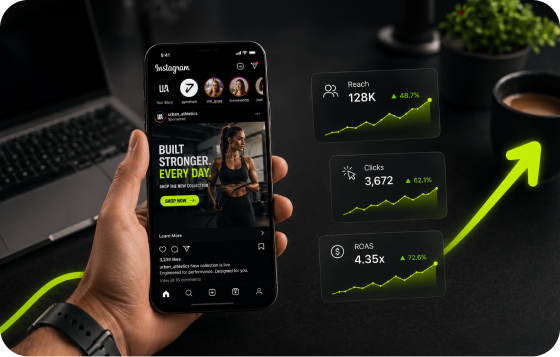


The team that ships the most creative wins.
3,500+ assets a day, 200+ brands, $150M+ in spend. That's the lever.
See how we run paid social
Paid social is the practice of buying advertising on social media platforms to reach defined audiences beyond your existing followers. You set an objective, define a target audience, pay to deliver content to them, and measure what happens. That’s the discipline. It runs on audience targeting, creative delivery, and performance measurement, all working together.
The teams that win at paid social are the ones with the fastest creative velocity. Shipping, testing, and iterating faster than the competition. Read more on that below.
What Is Paid Social?
Paid social means buying ad delivery on social platforms. The paid social meaning is straightforward: you pay the platform auction to show your content to people who match your targeting criteria, regardless of whether they follow you. Your ad appears in their feed, stories, or between videos. It looks like content, but it’s paid placement.
Paid social vs organic social comes down to control, speed, and scale. Organic content reaches people who already follow you, subject to the platform’s algorithm, which for most business accounts delivers organic reach to under 5% of followers. Paid social bypasses the algorithm. You define the audience, the budget, the schedule, and the objective. The platform delivers to your specifications.
The key differences:
| Organic Social | Paid Social | |
|---|---|---|
| Reach | Followers only (algorithm-dependent) | Any defined audience |
| Speed | Slow build | Immediate |
| Cost | Time | Budget |
| Control | Low | High |
| Scalability | Limited | Budget-limited |
| Measurement | Engagement signals only | Full-funnel attribution |
Paid social advertising covers feed ads, video ads, stories, carousels, collection ads, lead forms, app install ads, shopping ads, and more across platforms with different audiences, different auction mechanics, and different creative requirements. Treating it as one format is where most budgets go wrong.
Paid Social vs Paid Search
Both are forms of paid media. The fundamental difference is intent.
Paid search captures demand that already exists. Someone types “conveyancing solicitor London” into Google. They’re already looking. You bid to be the answer. The intent signal is explicit and strong.
Paid social creates and captures demand by interrupting browsing. Someone scrolling Instagram isn’t searching for your product. Your ad appears because they match your audience criteria: demographics, interests, behaviours, or similarity to your existing customers. You’re reaching them before they’ve searched.
This changes the creative, the offer, the funnel stage, and the measurement model.
| Paid Search | Paid Social | |
|---|---|---|
| Intent | High — user is actively searching | Low — user is browsing |
| Creative role | Ad copy and landing page | Creative is the targeting signal |
| Best for | Capturing existing demand | Building and activating new demand |
| Funnel stage | Lower funnel | Full funnel |
| Audience | Keyword-defined | Interest/behaviour/lookalike-defined |
| Platforms | Google, Bing | Meta, TikTok, LinkedIn, Pinterest |
The two channels work together. Search captures what social builds. For a full breakdown of how paid search operates, see our What Is Paid Search? guide.
The Main Paid Social Platforms
Meta (Facebook and Instagram)
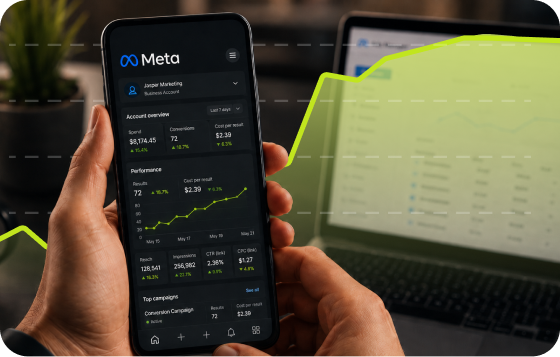
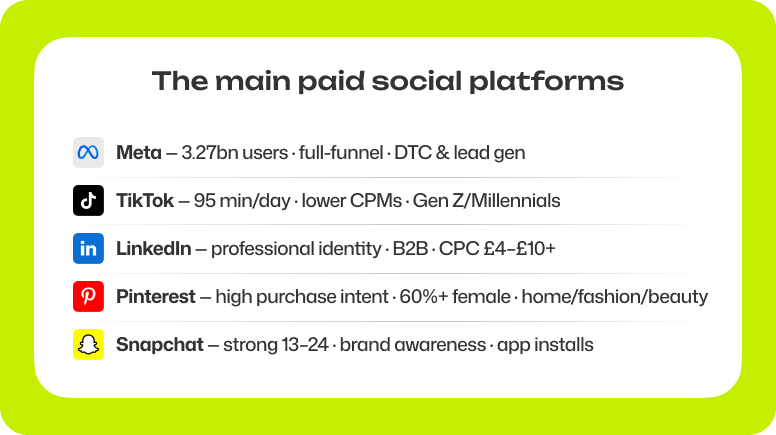
The largest paid social ecosystem in the world. 3.27 billion monthly active users across Facebook, Instagram, Messenger, and Audience Network. The targeting infrastructure is the most sophisticated in paid social: custom audiences, lookalikes, interest stacks, Advantage+ AI-optimised delivery. Full-funnel capability from awareness to purchase.
Best for: DTC eCommerce, lead generation, app installs, B2C brands with meaningful creative budgets. Particularly strong for retargeting and for brands where visual storytelling drives conversion.
Formats: Feed image and video, Stories, Reels, Carousel, Collection, Instant Experience, Shopping, Lead Ads.
TikTok
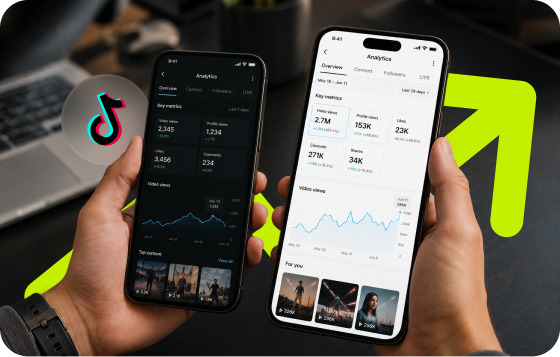
Algorithm-first delivery. TikTok’s system distributes based on watch time and engagement signals. Creative quality is the primary targeting lever. The platform skews younger (18–34) but is quickly broadening. The average session time of 95 minutes/day is the highest of any social platform. CPMs are generally lower than Meta.
Best for: Brands with strong creative velocity, DTC products with visual appeal, app installs, and brands targeting Gen Z and younger Millennials. TikTok Shop enables in-app purchase, making it a full commerce channel.
Formats: In-Feed Video, TopView, Spark Ads, Branded Hashtag Challenges, TikTok Shopping.
The only social platform with professional identity at its core. You can target by job title, company, industry, seniority, and skills using verified professional data. CPCs are the highest in paid social (£4–£10+), but audience quality for B2B is unmatched. Also available as a targeting layer on Microsoft Advertising for lower-CPC reach. See our Bing Ads: The Complete Guide for how that works.
Best for: B2B lead generation, enterprise software, recruitment, professional services, and high-ticket B2C targeting professionals.
Formats: Sponsored Content, Message Ads, Dynamic Ads, Lead Gen Forms.
High-purchase-intent platform. Users actively search for ideas, products, and inspiration, making Pinterest intent closer to search than typical social. Skews female (60%+), 25–44 age bracket. Strong for home, fashion, beauty, food, and weddings.
Best for: eCommerce with visually appealing products, lifestyle brands, retailers targeting considered purchase decisions.
Formats: Promoted Pins, Video Pins, Shopping Ads, Collections.
Snapchat
Reaches 18–34 year olds with strong penetration in 13–24. Full-screen vertical formats with high attention but lower purchase intent than Meta or TikTok. Useful for brand awareness and app installs at scale, particularly for younger demographics in entertainment, fashion, and gaming.
Best for: Youth-focused brand awareness, app installs, entertainment, and gaming verticals.
Formats: Snap Ads, Collection Ads, Story Ads, Filters, Lenses.
How Paid Social Works
The Auction
Every ad impression on every paid social platform is sold through a real-time auction. When a user matches your targeting criteria, and an ad slot becomes available, your ad competes against every other advertiser targeting the same person at the same moment.
On Meta, the auction winner is determined by Total Value: your bid multiplied by estimated action rate (how likely the user is to take the action you’re optimising for), plus ad quality. On TikTok, watch time and engagement signals drive a similar quality weighting.
A lower bid with high creative quality and strong relevance can outperform a higher bid with weak creative. Placement is earned through relevance.
Creative-Led Delivery
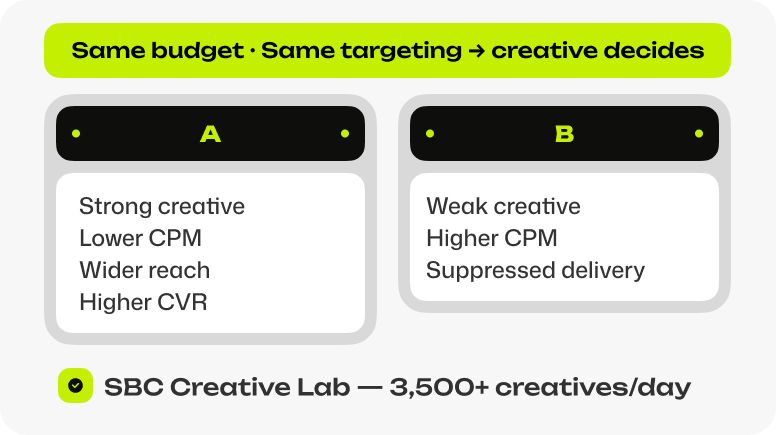
The most important thing to understand about modern paid social: creative is the targeting.
On Meta’s Advantage+ and TikTok’s algorithm, the platform uses creative signals to find the right audience. The algorithm observes who engages with your ad through click-through rate, watch time, saves, shares, and uses those signals to identify and reach more people who will respond similarly. A strong creative expands your effective audience. A weak one suppresses delivery and raises CPM.
The practical implication: two advertisers with identical budgets and targeting will get very different results if their creative quality differs. The advertiser with better creative pays less per impression, reaches more relevant people, and converts at a higher rate. Creative velocity is the differentiator.
SBC’s Creative Lab ships 3,500+ creatives daily across client accounts. That throughput exists because more creative variation means faster discovery of winning angles, faster identification of fatigue, and consistently lower CPMs. It’s the primary performance lever in paid social today.
Building a Paid Social Strategy
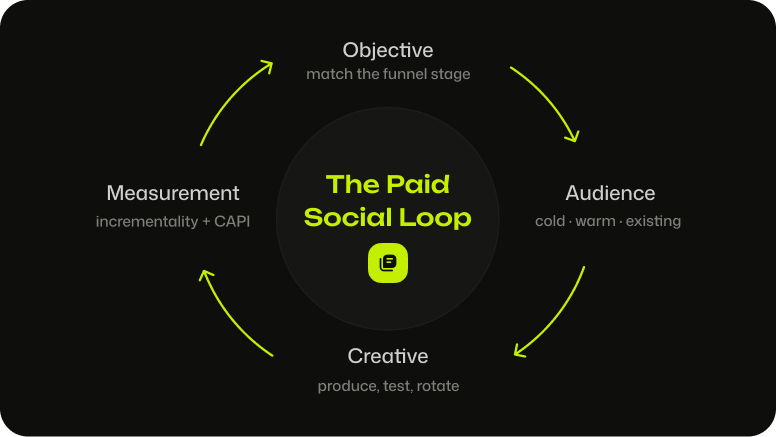
A paid social strategy is a closed loop: objective → audience → creative → measurement → iteration.
Objective first. Your campaign objective determines how the platform bids, who it targets, and what it optimises for. Awareness campaigns optimise for reach and impressions. Traffic campaigns optimise for clicks. Conversion campaigns optimise for purchases, leads, or app installs. Running a conversion objective on a cold audience with no conversion history will be expensive and slow. Start with objectives that match your funnel stage.
Audience architecture. Three layers work together: cold prospecting (new audiences defined by interest, behaviour, or lookalike), warm retargeting (people who’ve visited your site, watched your video, engaged with your content), and existing customers (for exclusions, upsells, or retention). Each layer needs a different creative and different objectives.
Creative system. The brief, production process, testing framework, and rotation cadence. On Meta, creative fatigue sets in within 5–10 days on a single asset. On TikTok, faster. Your creative system needs to be producing new variations before performance drops.
Measurement. What you track determines what you optimise. Platform-reported ROAS is unreliable as a standalone metric because it overcounts. It attributes clicks to conversions that would have happened anyway. Incrementality testing (geo-split or holdout) gives you the real number: how much additional revenue did the ads actually drive?
For a deeper build of this loop, see our Paid Social Strategy guide.
Creative and Measurement on Paid Social
Creative Velocity
The team that ships and tests the most creative wins. Borne out across 200+ brands and $150M+ in managed spend.
Creative fatigue is real and fast. A single ad running without rotation sees CTR and conversion rate decline within 5–10 days on Meta, faster on TikTok. Most brands underestimate how much new creative they need to maintain performance. Most agencies underdeliver on creative volume because their model isn’t built for it.
At scale, the question is: “How do we find the best ad as fast as possible and keep finding new ones?” That requires a production system, a testing framework, and a rotation cadence.
What to measure per creative:
- Hook rate (first 3 seconds view-through rate) — is it stopping the scroll?
- Hold rate (watch time past 50%) — is it holding attention?
- CTR — is it driving action?
- CPA or CVR — is it converting?
Creatives that fail on hook rate get cut. Creatives that win get iterated: new hook, same body; new format, same angle. The winners build a library. The library informs the next brief.
Measurement and Attribution
Pixel tracking captures what happens on your site after a click. It’s the baseline, but it’s incomplete. iOS restrictions, ad blockers, and Safari’s Intelligent Tracking Prevention cut signal from a meaningful portion of conversions.
Conversions API (CAPI) restores this signal with server-side tracking. Events fire directly from your server to the platform, bypassing browser restrictions. For Meta specifically, CAPI implementation typically recovers 15–35% of lost conversion signals. Running without it means your campaign data is systematically underreporting.
Incrementality testing is how you find out if your ads are actually driving additional revenue. A geo-split test (running ads in some regions and not others) isolates the real impact from paid social, separate from organic activity and natural demand.
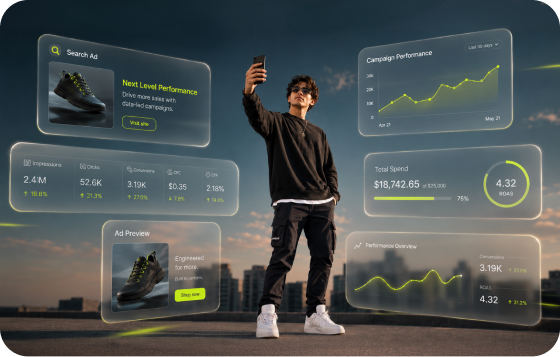
SBC Hub gives clients real-time visibility into spend, creative performance, and attribution data across all campaigns. Decisions get made on actual data. Clients retain full ownership of their pixels, audiences, and account data with complete export visibility.
How Much Does Paid Social Cost? (And Common Pitfalls)
Cost Ranges
Paid social costs depend on platform, objective, audience competition, and creative quality.
Meta UK benchmarks (2026):
- Average CPC: £0.92–£1.50
- Average CPM: £8–£18 (Feed); £5.50–£9 (Reels)
- Typical CPA: £15–£80 depending on industry and funnel
TikTok UK benchmarks (2026):
- CPM: £3–£10 (lower than Meta due to less advertiser competition)
- CPC: £0.20–£0.80
- CPA: highly variable by vertical and creative quality
LinkedIn: CPCs of £4–£10+, but significantly higher conversion quality for B2B.
For a full breakdown of Meta costs, see How Much Do Facebook (Meta) Ads Cost.
Minimum meaningful budget: £1,000–£1,500/month for most UK advertisers running conversion campaigns. Below that, you won’t generate enough conversion events to exit the learning phase or make statistically meaningful creative decisions.
Common Pitfalls
Running a single creative. One ad fatigues, CPM rises, performance drops, and the temptation is to increase the budget. The fix is more creative variation.
Audience targeting that’s too narrow. Tight interest stacks reduce the auction pool and push CPMs up. Modern platforms perform better on broad targeting once you have sufficient conversion data.
No server-side tracking. Running without CAPI means the platform is optimising on incomplete signal, which produces inflated CPCs and poor audience calibration. CAPI setup should precede campaign launch.
Creative fatigue ignored. Most teams find out about creative fatigue when ROAS drops. By then, the signal was there for days: frequency rising, CTR falling. A weekly rotation cadence prevents this.
Treating paid social in isolation. Paid social builds and activates demand. Paid search captures it. Running paid social without a wider funnel means paying to reach people you can’t convert because there’s nothing to catch them downstream. For the full channel picture, see our services overview.
When to Hire a Paid Social Agency
Running paid social yourself is viable at lower spend levels, particularly if you have a designer and some tolerance for iteration. The signals that you’ve outgrown that approach:
- Monthly spend is above £3,000, and creative production has become the bottleneck
- You’re running the same creatives for more than two weeks without rotation
- Your pixel is misconfigured, or you’re not running CAPI
- You have no incrementality data and don’t know how much of your ROAS is real
- You’re managing campaigns manually without a testing framework
- You need to scale across multiple platforms with different creative requirements
At that point, the gap between what a well-run paid social operation delivers and what you’re currently getting is almost always larger than the agency fee.
What to look for in a paid social agency: creative velocity, attribution rigour, and data ownership. Can they produce enough creative variation? Do they measure incrementality? Do you retain your pixels, audiences, and account access?
SBC manages $150M+ in paid social spend across 200+ brands. Clients retain full data ownership: pixels, audiences, and account access, with complete visibility via SBC Hub. Run paid social with operators who ship 3,500+ creatives a day.
What is paid social?

What is the difference between paid social and organic social?

What is the difference between paid social and paid search?
Which paid social platform should I use?
How much does paid social advertising cost?
Do I need a paid social agency?
What is paid social media advertising?