
How much does it cost to advertise on TikTok in 2026?


What Will TikTok Ads Cost You?
Get a realistic projection based on your industry, goals, and budget
Get a Custom Estimate
Quick Summary
TikTok ad costs in 2026 range from $4 to $10 CPM and $0.17 to $1.50 CPC for standard In-Feed placements. But those numbers mean very little without context, because what you actually pay depends heavily on your industry and your creative quality. This guide breaks down the real benchmarks and explains what moves costs up or down. It covers the parts most advertisers only learn about after things go wrong.
How Much Does it Cost to Advertise on TikTok: 2026 Benchmarks
These are the current averages across standard auction placements:
| Metric | 2026 Range |
|---|---|
| CPM (Cost Per 1000 Impressions) | $4.20 – $9.16 |
| CPC (Cost Per Click) | $0.17 – $1.50 |
| CPE (Cost Per Engagement) | $0.01 – $0.07 |
| CPI (Cost Per APP Install) | $0.50 – $1.80 |
| Minimum daily budget (campaign) | $50/day |
| Minimum daily budget (ad group) | $20/day |
TikTok’s average CPM of around $9.16 is still roughly 30% lower than Facebook’s $14.91 average. That gap is narrowing as more advertisers move budget to the platform, but TikTok remains more cost-efficient for reach, especially in consumer verticals.
Industry makes a significant difference. Finance and SaaS advertisers regularly see CPMs above $11 because of audience competition. Beauty and fashion brands typically land between $5 and $8. Health and fitness averages around $6.50. If you’re in a competitive industry, your baseline cost is already higher regardless of creative quality.
TikTok Ad Formats and Their Costs
In-Feed Ads
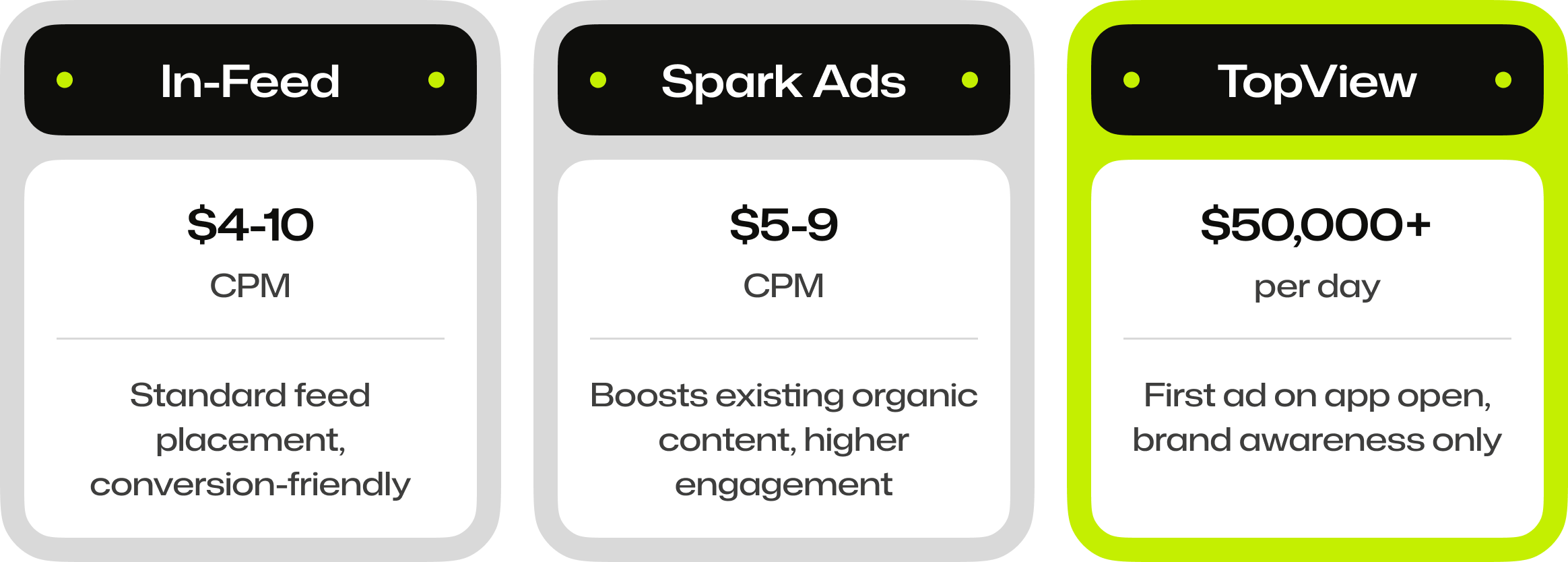
The standard performance format. These appear natively in the For You feed. They run up to 60 seconds and can be optimized for conversions or video views. Most advertisers running direct response campaigns start here.
Cost range: $4-$10 CPM / $0.17-$1.50 CPC
In 2026, TikTok’s Video Shopping Ads format has become the default for e-commerce campaigns within In-Feed. It often delivers slightly lower CPMs than static image formats because TikTok algorithmically pushes in-app shopping behavior.
Sparks Ads
Spark ads promote existing organic content, either your own posts or creator content you have authorization to boost. Because the ad runs from a real profile rather than a standalone ad creative, engagement accumulates on the original post and builds social proof over time.
Cost range: $5-$9 CPM
Spark Ads can lower CPM by up to 20% compared to standard In-Feed placements, largely because native-feeling content earns higher engagement scores from the algorithm. For brands with a UGC pipeline or strong organic presence, this is usually the most efficient format available. You can see how SBC Performance approaches TikTok advertising if you want a clearer picture of what a managed setup looks like.
TopView
TopView is the first ad a user sees when they open TikTok. Full-Screen, sound on, up to 60 seconds. TopView is the brand awareness format, and it doesn’t optimize for conversions.
Cost range: $50000+ per day for managed placements
Unless you have a specific reach objective and a budget that supports it, this format isn’t relevant to most performance advertisers.
Brand Takeover
Similar to TopView but with exclusive category ownership: only one advertiser per category per day. Available in static image or video format.
Cost range: $50000 – $100000+ per day (flat rate)
This is an enterprise format. Not action-based and not designed for direct response.
Branded Hashtag Challenges
A 3-6 day placement on TikTok’s Discovery page that invites users to create content around a branded hashtag. High engagement potential but no meaningful ROAS control.
Cost range: $100000 – $200000+ for the full package
Works for brand lift campaigns with large budgets. Not a performance marketing tool.
TikTok Pricing Models Explained
CPM
You pay per 1000 impressions regardless of clicks or conversions. Good for awareness campaigns and for amplifying high-engagement creatives that earn organic distribution, top of paid reach.
CPC
You pay only when someone clicks. Most traffic campaigns and landing page tests start here. Average CPC across industries sits between $0.35 and $1.00.
oCPM
TikTok’s optimized CPM model lets the algorithm target users most likely to complete your chosen action, whether that’s a purchase or a lead submission. For conversion campaigns with enough pixel data (roughly 50+ conversions per week), oCPM typically outperforms manual CPC bidding.
CPA
Cost per acquisition isn’t a bidding model, but it’s the metric that determines whether a campaign is actually profitable. There’s no universal benchmark. A lead-gen campaign in finance might target a $15 CPA. A DTC brand might tolerate $40-$80, depending on customer lifetime value. Your target CPA comes from your margin math, not from platform averages.
Minimum Budgets
Campaign level minimum is $50/day. Ad group level minimum is $20/day/ For any test to produce usable data, plan on spending at least $500-$1000 before drawing any conclusions. Campaigns that don’t exit the learning phase don’t produce reliable results.
What Affects TikTok Ad Cost

Creative Quality
Creativity is the biggest cost variable on TikTok, more so than on Meta or Google. The algorithm rewards ads that earn genuine engagement with lower CPMs and better delivery. Ads that get skipped get throttled regardless of bid.
UGC-style, native-looking content delivers 30-40% lower CPMS than polished brand video. Ads with strong watch-through rates can cost 40-60% less per conversion than low engagement creatives. Your creative quality directly affects media efficiency.
Audience and Competition
The more advertisers competing for the same audience segment, the higher the CPM. Finance, insurance, and SaaS audiences carry consistently higher costs because of the competitive bidding pressure. Consumer categories like food and fashion are typically cheaper.
Overly narrow targeting makes costs worse. A tight interest stack shrinks your auction pool and drives CPMs up. Starting broad and letting TikTok’s algorithm identify your best audience often produces lower costs than manual interest targeting, especially early in a campaign.
Bidding Strategy
Lowest Cost (automatic bidding) gives TikTok full optimization freedom. It’s efficient during the learning phase, but can become unstable as you scale and spend significantly.
Cost Cap sets a maximum target CPA and is more predictable at scale, but delivery slows if your cap is too aggressive. Setting a cost cap before you have stable conversion data usually kills optimization before it starts.
Bid Cap sets a ceiling on CPM or CPC. This is useful for experienced buyers managing auction pressure during competitive periods.
Seasonality
Q4 creates CPM increases of 20-40% across all categories. Black Friday and the Christmas period create the biggest spikes. Valentine’s Day and major regional events like 11.11 can also push costs up noticeably. If your CAC projections don’t account for seasonal CPM variance, they’ll be wrong.
How to Reduce TikTok Advertising Costs
Structured Creative Testing
Finding creatives that TikTok rewards is the most reliable way to lower CPM. That requires volume. Running 8-12 creatives per ad group, spending $50-$100 on each to identify top performers by watch-through rate and CTR, then scaling winners is a standard approach. Refreshing creatives every 2-3 weeks prevents ad fatigue from driving costs back up.
UGC and Creator Content
Authentic, first-person content outperforms brand-produced videos consistently on TikTok. Micro-creators with 10K-100K followers usually deliver stronger performance than macro-influencers because their audiences are more engaged and their content reads as organic. Working with multiple micro-creators simultaneously gives you creative volume and variation, which is what structured testing actually requires.
Targeting Approach
Broad targeting with strong creative typically beats narrow interest stacks. When your pixel has enough data, build lookalike audiences from your highest-value events: purchasers or high-intent page visitors. Retargeting users who watched 25-75% of your video ads is usually the most cost-efficient segment of your funnel because the intent is already established.
Attribution and Analysis
If you’re measuring performance only through TikTok’s native dashboard, you’re working with incomplete data. Browser-based pixel tracking loses 30-40% of sessions to ad blockers and iOS restrictions. Server-side tracking through TikTok’s Events API solves that.
Adding third-party attribution gives you a cross-platform view that separates real incremental performance from attributed overlap. When you know what’s actually influencing results, you stop spending on what isn’t.
AVERAGES DON'T TELL YOUR STORY
Get a cost projection specific to your vertical and budget
Why TikTok Ad Costs Become Unpredictable
Budget is stable, targeting is consistent, creatives are fresh, but costs keep swinging. This is one of the most common complaints from advertisers scaling on TikTok. And it usually traces back to a few specific issues.
Account Bands and Policy Violations
TikTok’s ad policies are stricter and less transparent than Meta’s, particularly in health and finance. A single policy violation can result in ad rejection or a permanent ban, which means losing pixel history and all the campaign performance data accumulated in that account.
Most advertisers in these verticals don’t have a compliance system in place. They react after bans happen. This creates repeated learning phase disruptions and cost spikes that look random but aren’t.
A proper compliance setup means reviewing creative against TikTok’s category-specific policies before launch and structuring accounts to isolate higher-risk campaigns. If you’re not sure where your setup stands, a TikTok Ads audit will usually surface the gaps before they become expensive.
Learning Phase Resets
Any significant change to a campaign can reset TikTok’s learning phase: new creative added to an existing ad group, a budget increase above 20%, or bid adjustments. During the learning phase, delivery is unstable, and CPMs are increased. Advertisers who make frequent changes never let the algorithm stabilize.
Scaling without disrupting the learning phase requires a specific workflow: duplicate rather than edit, increase budget in increments unders 20%, test new creatives in separate ad groups instead of replacing existing ones.
Poor Attribution
If your CPA looks acceptable in TikTok Ads Manager but your actual revenue doesn’t reflect it, attribution is probably the issue. View-through attribution windows inflate reported conversion. Browser-side pixel data has significant gaps. Without server-side validation, you may be optimizing toward a CPA that’s 20-50% lower than your real acquisition cost.
Scaling based on inaccurate CPA data means scaling into unprofitable territory, and the problem only becomes visible after you’ve already spent the budget.
How to Scale TikTok Ads Without Losing Control
Scaling TikTok spend is more than a budget decision. Increasing spend without supporting infrastructure produces higher CPMs and declining ROAS.
Compliance Before Scale
Before increasing spend significantly, verify that your creative is compliant with TikTok’s policies for your specific category and that your landing pages pass TikTok’s destination URL review. Scaling a non-compliant setup just accelerates how quickly problems surface. If you’re building this out from scratch, SBC Performance’s performance marketing services can cover the full infrastructure side of this.
Creative Production at Scale
Ad fatigue is the most consistent cost driver for advertisers scaling past $50K/month on TikTok. As audiences see the same creatives repeatedly, engagement drops and CPMs climb. Staying ahead of fatigue requires a production system that generates and rotates new content consistently, typically 15-30 new variations per month at a significant scale.
Budget Scaling Protocol
Keep daily budget increases under 20% to avoid learning phase resets. When scaling a winning ad group, duplicate it and increase the budget on the new version rather than editing the original. Monitor CPM trends daily. If CPM climbs above $15 without a corresponding improvement in conversion rate, refresh creative before increasing bids.
Reporting Infrastructure
At scale, manual reporting creates lag. By the time a problem appears in weekly exports, the budget is already spent. Real-time dashboards that flag CPM spikes and conversion rate drops allow teams to respond before costs compound.
Is TikTok Advertising Worth It in 2026?
For brands with the right product and proper infrastructure in place, yes. TikTok’s CPMs are lower than Facebook’s, and the platform’s commerce integrations have matured significantly. DTC brands and app advertisers with visually compelling products have a real cost advantage here compared to other paid social channels.
The platform requires a higher operational investment than most advertisers expect. Attribution setup and compliance management need to be in place before scaling makes sense. Advertisers who treat TikTok like a simple traffic source and expect stable returns without that groundwork will end up frustrated.
The results aren’t automatic. If you want to build a setup that actually scales, talk to a performance specialist about what that looks like for your specific vertical and budget.
FAQs
How much does it cost to start advertising on TikTok?

What is the average CPM on TikTok in 2026?

Why is my TikTok CPM so high?
What’s the difference between Lowest Cost and Cost Cap bidding?
How does creative quality affect costs?
Are TikTok ads worth it for B2B?
What’s the actual risk of account bans?