


Paying too much per impression?
3,500+ assets a day, $150M+ in Meta spend. We know where it leaks.
Get a free Meta ads cost audit
How Much Do Facebook (Meta) Ads Cost?
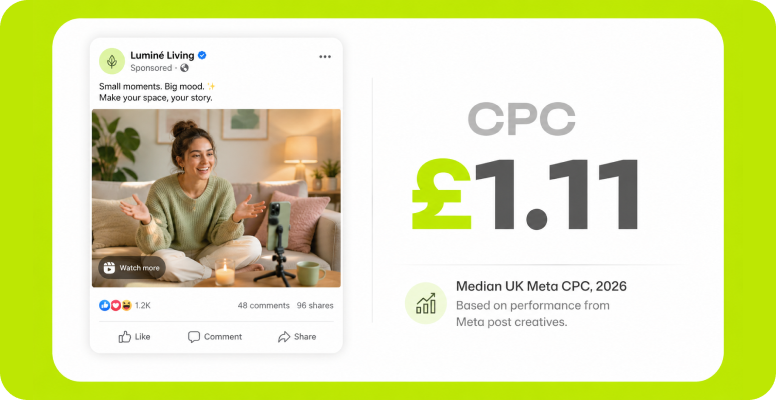
In the UK, the average Facebook ads cost per click sits between £0.92 and £1.50 across most campaign types in 2026, with a median of around £1.11. CPM (cost per 1,000 impressions) runs £8–£18 for most campaigns, rising to £26+ in Q4. CPA varies significantly by industry, but most UK advertisers pay £15–£80 per conversion depending on objective and sector. If you’re trying to understand how much Facebook advertising costs before committing a budget, these are the real UK figures for 2026.
Quick summary:
- Average UK Facebook CPC: £0.92–£1.50 (median £1.11)
- Average UK Meta CPM: £8–£18 (Q4 peak: £25+)
- Typical CPA range: £15–£80 depending on industry and objective
- Minimum meaningful test budget: £1,000–£1,500/month
- Agency management fees: £500–£2,500/month flat, or 10–20% of spend
- New from July 2026: Meta charges a 2–5% location fee on UK ad delivery, added as a separate line item on invoices
From the SBC desk: Managing $150M+ in Meta ad spend across 200+ brands gives us a direct view of what UK advertisers actually pay. The ranges above reflect real account data from 2026, built from live UK campaigns rather than reworked global averages from US-dominated benchmark reports.
Facebook Ads Cost Benchmarks 2026
The table below covers UK-specific data for 2026. The average cost of Facebook ads varies considerably by objective, placement, audience size, and creative quality. Treat these as directional ranges. The cost of Facebook ads in the UK runs higher than global averages due to a smaller addressable audience and a competitive advertiser base. CPA figures are illustrative ranges based on managed account data.
| Objective/Industry | Avg CPC (£) | Avg CPM (£) | Typical CPA (£) | Avg CTR |
|---|---|---|---|---|
| Traffic/Clicks | £0.30–£0.80 | £5–£10 | N/A | 1.5–3.0% |
| Lead Generation | £0.80–£2.50 | £8–£16 | £8–£40 | 0.8–1.5% |
| Conversions/Purchase | £0.90–£2.00 | £10–£18 | £20–£80 | 0.7–1.4% |
| eCommerce (Feed) | £0.60–£1.50 | £7.50–£14 | £15–£60 | 0.8–1.4% |
| eCommerce (Reels) | £0.40–£1.10 | £5.50–£9 | £12–£50 | 1.2–2.1% |
| Finance/Insurance | £1.50–£4.00 | £14–£22 | £30–£120 | 0.5–1.0% |
| Health & Beauty | £0.80–£2.00 | £10–£18 | £15–£60 | 0.9–1.6% |
| B2B/SaaS | £1.20–£3.50 | £12–£20 | £40–£150 | 0.4–0.9% |
| App Installs | £0.50–£1.50 | £6–£12 | £1.50–£5.00 | 0.6–1.2% |
Key notes on reading this table:
- Reels placements typically run 20–35% cheaper on CPC than Facebook Feed due to lower advertiser competition.
- Q4 (October-December) pushes CPMs 35–60% above these baselines due to holiday auction pressure. Fashion and beauty see the largest increases.
- Retargeting warm audiences costs more than cold prospecting. Expect CPMs to be 30 to 50% higher when bidding on your existing site visitors.
- London and other major UK cities run 10–20% above these national averages due to higher audience competition.
What You Actually Pay For
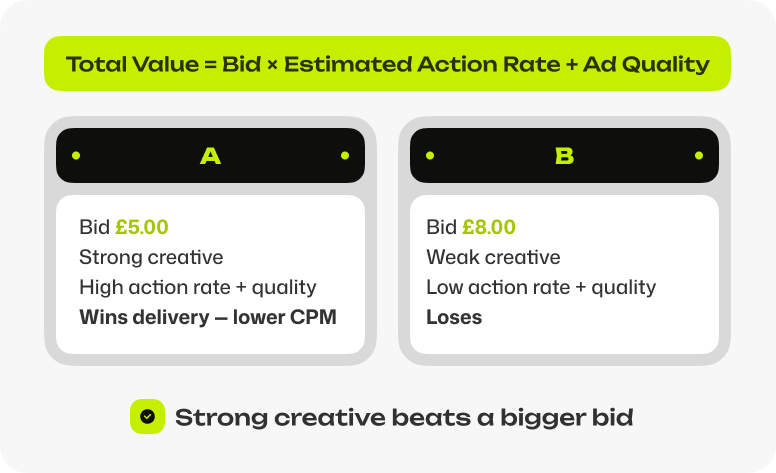
Meta’s ad auction works differently from a price list. You bid in a real-time auction against every other advertiser targeting the same audience at the same moment.
Meta determines your ad’s Total Value using this formula:
Total Value = Bid × Estimated Action Rate + Ad Quality
Your bid is what you’re willing to pay. The estimated action rate is Meta’s prediction of how likely your audience is to take the action you’re optimising for. Ad Quality reflects how people respond to your ad.
This means a lower bid with a high estimated action rate and strong ad quality can outperform a higher bid with weak creative. Placement is earned through relevance.
The practical implication: two advertisers targeting the same audience can pay very different CPCs. The difference comes down to creative quality and account structure. This is the most controllable aspect of Meta ads cost and the most commonly overlooked.
For more on how paid social advertising works, see our guide on paid social.
7 Factors That Change Your Facebook Ad Costs
1. Audience Size and Competition
The more advertisers targeting the same audience, the higher your CPM. Narrow interest adds up, and small custom audiences push costs up because multiple advertisers compete for limited impressions. Broad targeting with strong creative often delivers lower CPMs because Meta has more room to find the right people at the right price.
2. Creative Quality
This is the most controllable cost lever. Meta’s algorithm rewards ads that earn genuine engagement with lower CPMs and better delivery. An ad with a strong hook and a high click-through rate costs less per impression than one that users scroll past.
At SBC, our Creative Lab produces 3,500+ assets daily, because creative velocity directly reduces Facebook CPM over time. More tests mean faster discovery of winning angles, which means higher engagement scores and cheaper delivery. The gap between a high-performing and a low-performing creative on Meta can move CPM by 40–60%.
3. Relevance and Engagement Rate
Meta measures how your audience responds to your ad. Positive signals (saves, shares, purchases) lower your effective cost. Negative signals (hides, “report ad” clicks) raise it. An ad with a 2% CTR will cost significantly less per outcome than one with a 0.5% CTR targeting the same audience.
4. Campaign Objective
Your objective tells Meta what action to optimise for, which changes how it bids in the auction. Reach and awareness objectives are cheapest on a CPM basis. Conversion campaigns are more expensive per impression because Meta is competing harder to find users likely to purchase. Lead generation sits in between.
5. Placement
Facebook Feed, Instagram Feed, Reels, Stories, Audience Network, and Messenger all have different CPMs. Reels typically produce the lowest CPMs at present because advertiser adoption is lower than on Feed. The trade-off is that creative requirements differ. Vertical, short-form, native-feeling content performs on Reels while standard ad formats often underperform.
6. Seasonality
Q4 is expensive across all verticals. Black Friday and the Christmas window push UK Meta CPMs 35–60% above baseline. Facebook CPC in the UK peaks in December. SuperAds UK benchmark data shows CPMs reaching £26+ in December 2025. January is often the cheapest prospecting window of the year, with CPMs dropping 25–40% from November peaks.
7. Budget and Learning Phase
Meta’s algorithm needs data to optimise. Campaigns in the learning phase, typically the first 50 conversion events, deliver less efficient results while the system calibrates. Running too many ad sets on small budgets fragments this data and keeps campaigns in a permanent learning state. Consolidating budget into fewer, better-structured campaigns is one of the most reliable ways to improve cost efficiency.
How to Lower Your Facebook Ad Costs
Creative Velocity
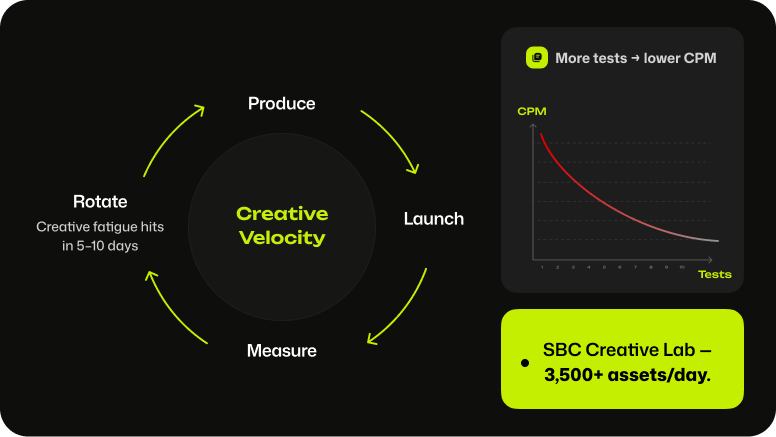
The fastest route to lower CPMs is a creative that earns high engagement. Meta rewards relevance, and ads that people genuinely interact with cost less to deliver. The challenge is that creative fatigue on Meta is fast. CTR and conversion rates often start declining within 5 to 10 days on a single asset.
The fix is creative velocity. A systematic process of producing, testing, and rotating new creative before fatigue sets in. SBC’s Creative Lab ships 3,500+ assets daily because, at scale, the creative pipeline is the primary cost lever. More variation means faster identification of winning hooks, which means lower CPMs and more efficient delivery.
Audience Structure
Overly narrow targeting increases CPM by shrinking the auction pool. Starting broad and letting Meta’s algorithm identify your best buyers via Advantage+ often delivers lower costs than manual interest stacking, particularly once you have sufficient conversion data.
Advantage+ campaigns can reduce cost per result by up to 44% compared to manual setups, according to AdAmigo’s 2026 benchmark analysis, but they require sufficient conversion volume and clean pixel data to work effectively.
Attribution and Signal Quality
Meta optimises toward the signal you give it. Poor pixel setup or misconfigured conversion events mean Meta is optimising on the wrong action, which produces inflated costs. Server-side tracking via Meta’s Conversions API (CAPI) restores signal lost to ad blockers and iOS restrictions, improving the quality of data Meta uses to find buyers and reducing wasted spend as a result.
SBC Hub gives clients real-time visibility into CPM trends, creative performance, and spend data across all campaigns. Issues get caught before they compound across a billing cycle. See how our Meta ads agency sets up tracking and attribution from day one.
How Much Should You Budget for Facebook Ads?
Your Facebook ads budget depends on the objective, industry, and how much conversion data you need to exit the learning phase. Here are realistic starting points:
By objective:
- Brand awareness/reach: £500–£1,500/month. Achievable at lower budgets because CPMs are lower, and you are not optimising for conversions.
- Traffic/engagement: £500–£2,000/month. Useful for warming audiences before conversion campaigns.
- Lead generation: £1,000–£3,000/month. Need enough budget to generate 50+ leads per month for the algorithm to optimise effectively.
- Conversions/purchases: £1,500–£5,000/month for SMBs. Below this, the learning phase struggles to exit.
- App installs: £1,000–£3,000/month. Creative volume matters more here than on other objectives.
By business type:
| Business Type | Suggested Starting Budget | Notes |
|---|---|---|
| Local service/SMB | £800–£2,000/month | Lead gen or awareness; tight geo-targeting |
| eCommerce | £2,000–£8,000/month | Prospecting and retargeting; Shopping or Advantage+ |
| B2B/SaaS | £1,500–£5,000/month | Lead gen; longer sales cycles need remarketing layered in |
| App/mobile | £1,000–£3,000/month | Creative volume critical; AEO/VO optimisation |
These are starting points. The minimum for generating statistically meaningful data in most UK verticals is £1,000–£1,500/month. Below that, you are unlikely to generate enough conversion events to let the algorithm work. For the full picture on our performance services, see our services page.
When a Meta Ads Agency Pays for Itself
Running Meta ads yourself is viable at lower spend levels, particularly if you have a marketing background. The point where agency management starts to pay for itself:
- Monthly spend is above £3,000, and creative production has become a bottleneck
- You are running Advantage+ campaigns without clean pixel data or sufficient conversion events
- CPM has been rising for two months with no clear structural explanation
- Reporting shows impressions and clicks, but no revenue attribution
- You are spending time on campaign management that would be better spent on the business
At that point, the cost of poor account structure and slow creative iteration almost always exceeds the management fee. The question shifts from “can I afford an agency?” to “what is poorly managed spend actually costing me?”
Get a free Meta ads cost audit. We’ll model your CPC, CPM, and realistic CPA against $150M+ of managed spend. Book with our Meta ads team.
How much do Facebook ads cost per click in the UK?

What is the average CPM for Facebook ads in the UK?

How much should I spend on Facebook ads per month?
Why are my Facebook ad costs so high?
What is the difference between CPC and CPM on Facebook?
How does Facebook ad cost compare to Google Ads?
What is the new Meta UK location fee in 2026?