



Overpaying on Google Ads?
It's usually your account structure, not your budget. We manage £150M+ in UK ad spend and know where it leaks.
Book a free Google Ads review
How Much Do Google Ads Cost?
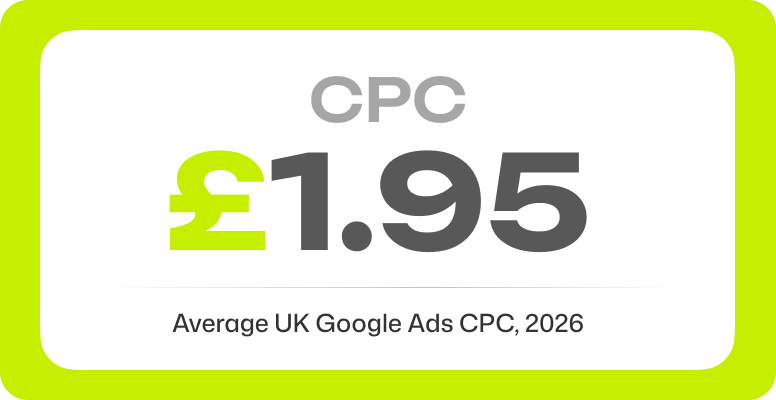
In the UK, the average cost per click on Google Search sits between £1.95 and £2.50 across most industries in 2026. Legal and finance verticals run significantly higher. Legal services average £4–£12 per click, depending on keyword competitiveness. The total cost of Google Ads for most UK SMBs lies between £1,000 and £10,000 per month. Management fees, if you work with an agency, typically add £500–£2,500/month on top, or 10–20% of spend.
Quick summary:
- Average UK Search CPC: £1.95 (cross-industry average)
- High-competition verticals (legal, finance): £4–£12 per click
- Typical SMB monthly ad spend: £1,000–£10,000
- Agency management fees: £500–£2,500/month flat, or 10-20% of spend
- Minimum meaningful test budget: ~£900/month (£30/day)
Google Ads Cost Benchmarks 2026
The table below shows the average Google Ads cost in the UK by industry for 2026. These are Search CPC averages. What you actually pay per click varies based on Quality Score, geo-targeting, and keyword match type. Display CPMs and typical CPAs are indicative ranges based on managed account data.
| Industry | Avg Search CPC (£) | Display CPM (£) | Typical CPA (£) |
| Legal/Solicitors | £4.00–£12.00 | £2.50–£5.00 | £80–£300 |
| Finance/Insurance | £3.50–£8.00 | £2.00–£4.50 | £60–£200 |
| Health & Dental | £2.00–£5.00 | £1.00–£2.50 | £30–£120 |
| Home Services/Trades | £1.50–£3.00 | £0.80–£2.00 | £25–£80 |
| B2B/SaaS | £2.50–£6.00 | £1.50–£3.50 | £50–£250 |
| eCommerce/Retail | £0.50–£2.00 | £0.30–£1.00 | £15–£60 |
| Travel | £1.00–£3.50 | £0.50–£1.50 | £20–£100 |
| Education | £1.50–£4.00 | £0.80–£2.00 | £30–£150 |
| Automotive | £1.00–£3.00 | £0.50–£1.50 | £20–£90 |
| Real Estate | £1.50–£4.50 | £1.00–£2.50 | £30–£120 |
Important to note, London CPCs typically run 15–30% above these national averages. A solicitor targeting “conveyancing solicitor” in central London can pay £12+ per click. The same keyword in Leeds might cost £6–£7.
Managing £150M+ in Google Ads spend gives SBC a direct view of these ranges across verticals, built from real UK account data rather than reworked US benchmarks.
What Determines Your Google Ads Cost
Quality Score
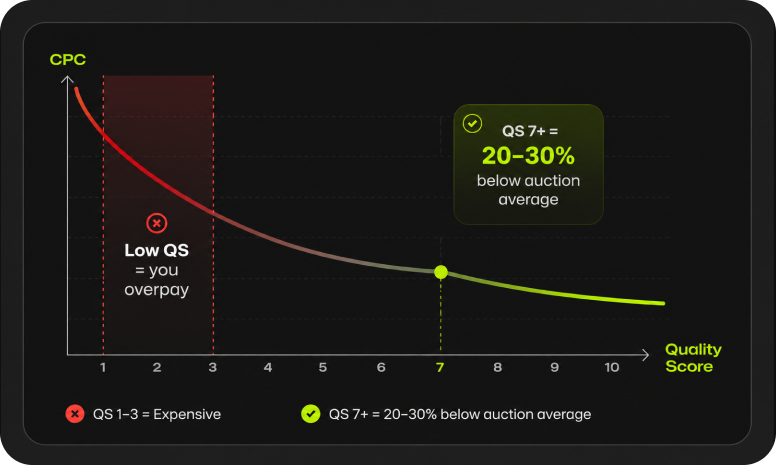
Quality Score is the single biggest controllable lever on CPC. Google scores every keyword from 1 to 10 based on expected click-through rate and landing page experience. A score of 7+ typically delivers CPCs 20–30% below the auction average for that keyword. A score of 3 or below means you’re paying a premium for the same position.
Most inflated CPCs trace back to poor Quality Scores. Mismatched ad copy, slow landing pages, and broad match keywords pulling irrelevant traffic. Fixing account structure and landing page relevance consistently is the fastest way to reduce cost per click.
Competition
The more advertisers bidding on a keyword, the higher the floor price is. Legal, finance, and insurance keywords are expensive because the lifetime value of a converted customer justifies high bids. Competitive CPCs in these verticals are unavoidable. What you can control is your Quality Score, which determines how much less than your competitors you pay for the same position.
Keyword Choice
Broad match keywords pull in wide, often irrelevant traffic. Phrase and exact match keywords cost more per click but convert better, which typically means lower cost per acquisition even if CPC is higher. Long-tail keywords (“divorce solicitor Manchester fixed fee”) almost always deliver lower CPCs and higher conversion rates than head terms (“divorce solicitor”).
Bidding Strategy
Manual CPC gives you full control. Smart Bidding (Target CPA, Target ROAS, Maximise Conversions) hands the work to Google’s algorithm. It performs well once you have sufficient conversion data, typically 50+ conversions per month. Running Smart Bidding on thin conversion data produces unstable CPCs and inflated costs.
Network
Search campaigns deliver the strongest intent and conversion rates. Display CPMs are lower (£0.30-£5 depending on targeting), but conversion rates are only a fraction of Search. Performance Max runs across all networks automatically. It can be efficient at scale, but requires careful asset group segmentation and audience signals to prevent wasted spend across low-intent placements.
How the Google Ads Auction Works
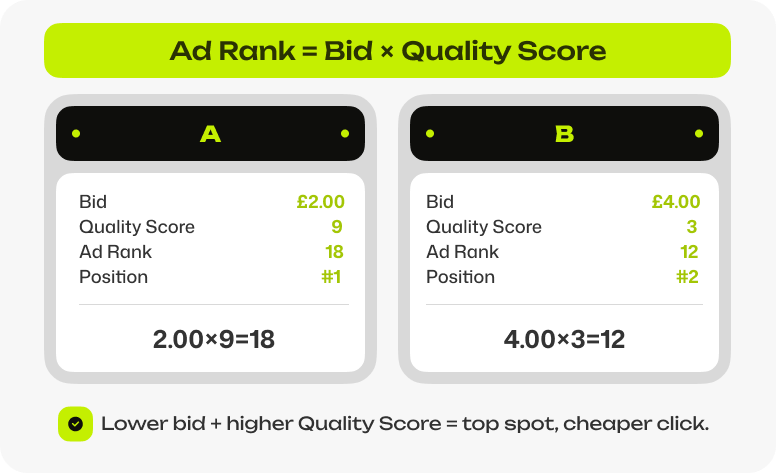
Google Ads is not a highest-bidder-wins system. Your ad position is determined by Ad Rank, calculated as:
Ad Rank = Bid × Quality Score (+ ad assets/extensions)
A lower bid with a higher Quality Score can outrank a higher bid with a lower score, and pay less per click to do it. You never pay your maximum bid. You pay just enough to beat the Ad Rank of the advertiser below you, plus £0.01.
In practice, if your Ad Rank is 10 and the advertiser below you has an Ad Rank of 7, you pay the minimum needed to maintain your position, often well below your stated maximum CPC.
Account structure and ad relevance are directly tied to what you pay per click, not just to quality metrics. For a deeper explanation of how the auction works, see our guide on how Google Ads work.
How Much Should You Budget?
Understanding your Google Ads budget before you launch saves you from running tests that don’t generate enough data to act on. Here’s how to think about it by campaign type and business size.
By Campaign Type
Search: The most intent-driven network. A starting budget of £1,000–£3,000/month is the minimum for meaningful data in most UK verticals. Below £30/day (£900/month), you will not generate enough clicks to exit the learning phase or make statistically meaningful decisions.
Display: Lower CPMs, but conversion rates are significantly lower than Search. Works best for remarketing and upper-funnel brand awareness. Can run effectively from £500/month, though the real value comes from being layered on top of Search.
Performance Max: Requires a larger budget to perform well. Google needs sufficient conversion data to work effectively. Starting below £2,000/month in ad spend typically produces inconsistent results. Asset group segmentation and proper audience signals are critical from day one.
By Business Type
| Business Type | Suggested Starting Budget | Notes |
| Local service (trades, dental, legal) | £1,000–£3,000/month | Search-first; geo-target tightly |
| eCommerce | £2,000–£10,000/month | Shopping + Search; PMax at scale |
| Lead generation/B2B | £1,500–£5,000/month | Search + remarketing; focus on CPA |
| SaaS | £2,000–£8,000/month | Long sales cycle; incremental budget increases |
These are starting points. The right budget is the one that generates enough conversion data to let the algorithm work and enough margin to justify the CPA. If you’re looking for paid search management to handle the complexity, see our services page.
Google Ads Management Costs
Ad spend is only part of the cost. If you are running campaigns yourself, your cost is time. If you work with an agency or freelancer, you pay a management fee on top of ad spend.
In-House vs Agency
In-house: Full control and institutional knowledge of your product. The typical fully-loaded cost of a competent PPC manager in the UK is £35,000–£55,000/year, including employer costs. At lower spend levels (under £5,000/month), in-house management is rarely cost-efficient unless the role is split across other responsibilities.
Agency: Access to cross-account data, broader tooling, and a team without the hiring overhead. The trade-off is that your account is one of many. Quality varies considerably, which is why understanding how an agency is structured matters as much as its fee.
For a comparison of UK PPC agencies by operational fit, see our best PPC management companies in the UK guide.
Fee Models
Flat retainer: A fixed monthly fee regardless of ad spend. Predictable cost; agency incentive is tied to performance rather than spend volume. Common range: £500-£2,500/month for SMBs, £3,000–£8,000/month for mid-market.
Percentage of spend: Typically 10–20% for SMBs. Scales with budget, which aligns incentives on growing accounts, but can create pressure to maintain spend over efficiency at scale.
Hybrid: A base retainer plus a performance component. The most aligned model in theory, but the most complex to negotiate. More common at larger spend levels.
Most UK SMBs working with an agency pay between £700 and £2,000/month in management fees on top of their ad spend.
How to Reduce Wasted Spend
Quality Score
This is the first thing to address on any underperforming account. Ad copy relevance and landing page speed are the two main levers. A properly structured account with tight ad groups and relevant landing pages consistently delivers lower CPCs than a poorly structured one, regardless of bid.
At SBC, our Creative Lab produces 3,500+ assets daily because weak creative is one of the most common drivers of poor Quality Score and inflated CPC. A strong hook that earns a high click-through rate directly reduces what you pay per click.
Negative Keywords
Broad match without a robust negative keyword list is one of the most reliable ways to burn budget. Regular search term mining, pulling the actual queries that triggered your ads, surfaces irrelevant traffic before it compounds. This is weekly work built into every well-managed account.
Landing Page Alignment
Google’s Quality Score algorithm assesses landing page experience as part of your score. A landing page that matches the user’s intent and loads quickly reduces bounce rate, improves conversion rate, and lowers CPC. Sending all ad traffic to a generic homepage is one of the most common and most costly mistakes in Google Ads.
Visibility Into Spend
You cannot reduce wasted spend on data you cannot see. SBC Hub gives clients real-time visibility into spend, CPC trends, and creative performance. Issues get caught before they compound across a billing cycle rather than surfacing in a monthly report.
When to Hire a Google Ads Agency
Running Google Ads yourself makes sense at low spend levels or when you have a marketing team with PPC experience. Signals that you have moved past DIY:
- Monthly spend is above £3,000, and you are not confident in your conversion tracking setup
- You are running Performance Max without segmented asset groups or audience signals
- CPC has been rising for more than two months with no structural explanation
- Your agency reports show clicks and impressions, but no revenue or CPA data
- You do not have admin access to your own Google Ads account
At that point, the cost of poor management almost always exceeds the management fee. If any of those apply, see what a structured Google Ads setup looks like with our Google Ads management team.
How much do Google Ads cost per click in the UK?

What is a good daily budget for Google Ads?

Is Google Ads worth it for small businesses?
Do you pay Google Ads per click or per impression?
Why are my Google Ads so expensive?
What is the difference between ad spend and management fees?